
The tank doesn't fail. It opens.
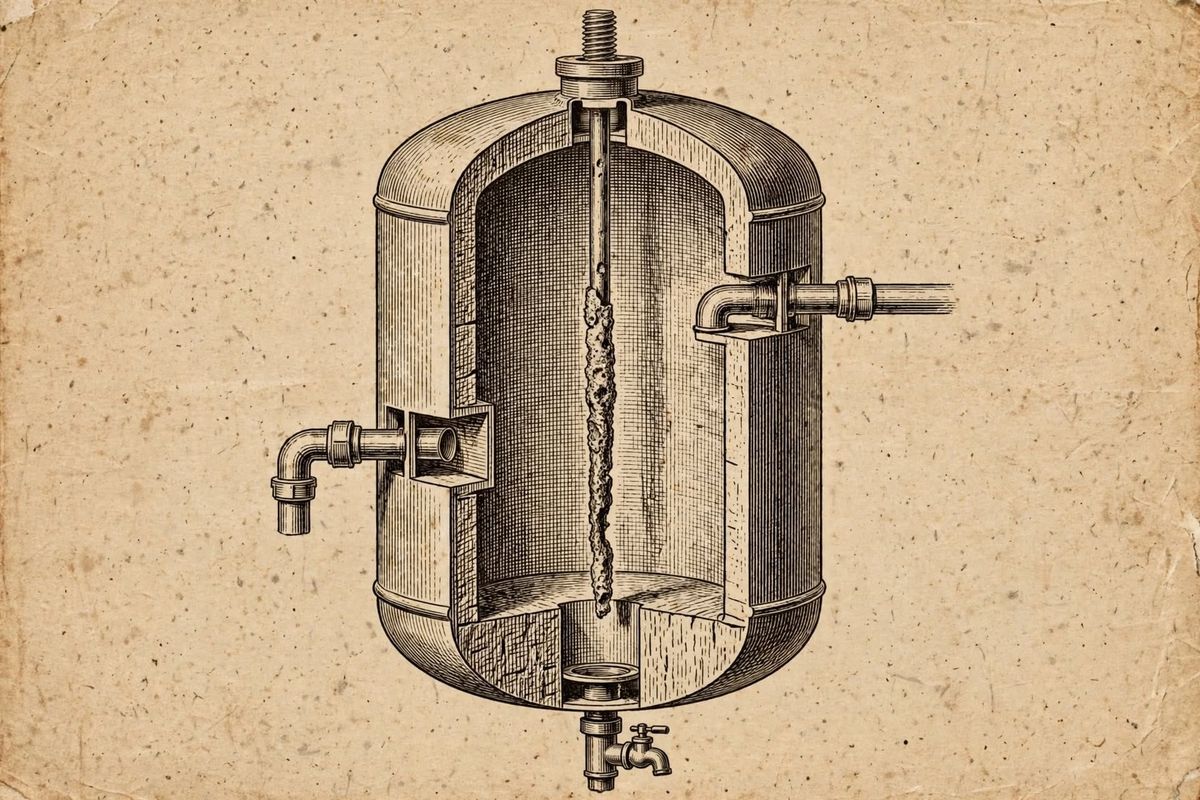
It's a consumable, like a furnace filter. It's just sealed under a cap where nobody looks.
Wendell here. Wednesdays are the house.
The Insurance Institute for Business & Home Safety once read through seven hundred claims where the water heater was the thing that went wrong. In sixty-nine percent of them the tank hadn't stopped heating at all. It had opened. A slow seep, or a split, and what ended it was water on the floor.
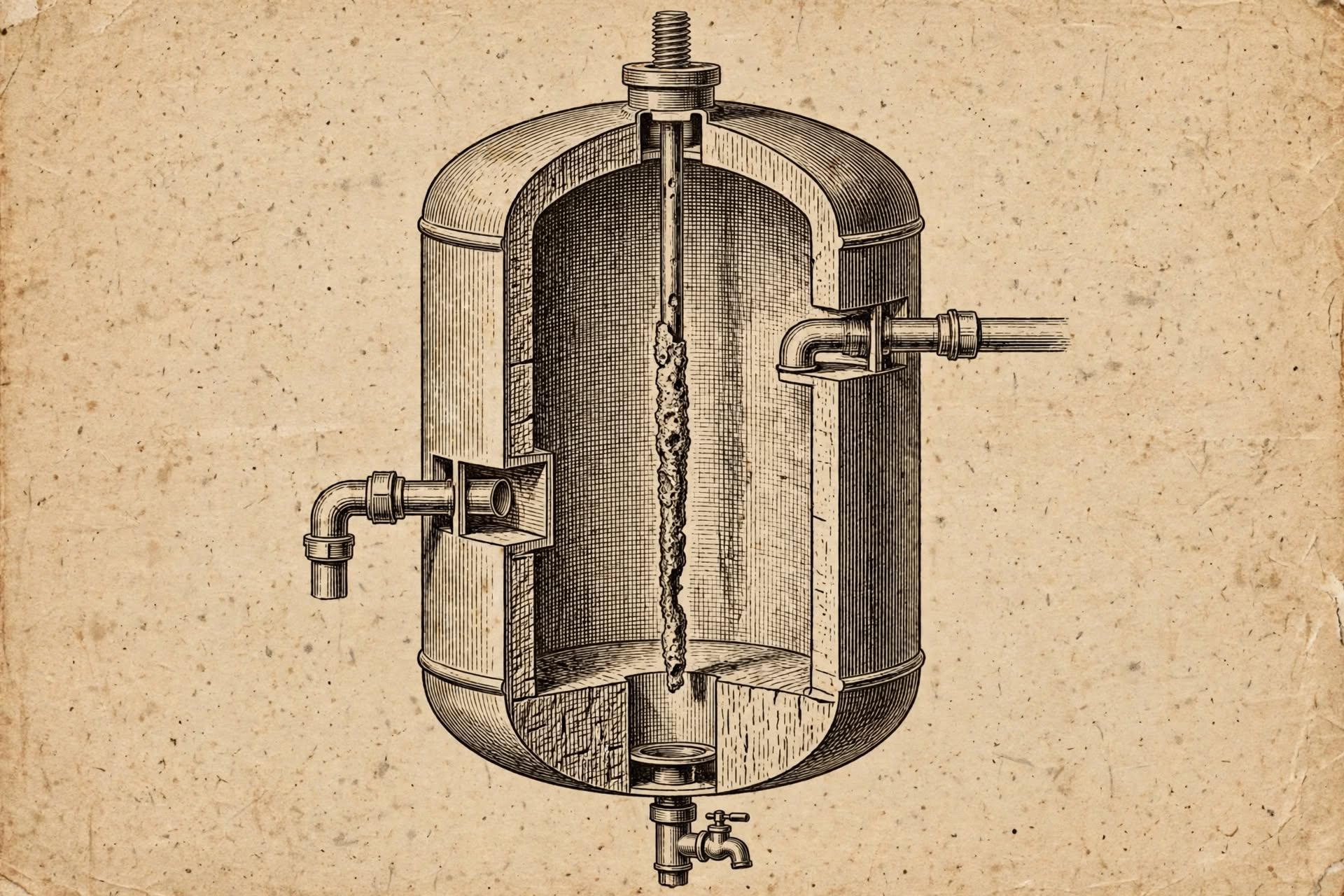
There's a part inside that tank whose entire job is to be destroyed so the tank isn't. Most people who own one have never laid eyes on it.
Put two different metals in water together and one starts eating the other. That isn't a fault, it's chemistry, and it happens every time. So you learn to choose which one gets eaten.
At the plant we bolted lumps of soft metal onto anything we couldn't afford to lose. Condensers, tanks, buried pipe. The water went after the soft metal and left the steel alone, and every so often a man came round and put fresh lumps on. Nobody thought it clever. It's just how you keep steel in water.
Your water heater has one hanging down inside it, through a plug in the top. It's called a sacrificial anode. Not a figure of speech — it is there to be used up.
So it runs out, the same way a furnace filter runs out. The difference is that a filter sits behind a panel you can open, while this one is under a cap on top of the tank that you have probably never lifted.
A literature review done for the Department of Energy by the Pacific Northwest National Laboratory says most homeowners aren't aware of the rod, or that they're supposed to inspect it. It also found that corrosion left alone can take more than half the life off a tank, and that tanks commonly leak for that precise reason. The rod went first, and then the steel.
Seven hundred claims, looked at one by one
Age of the average tank when it went
10.7 years
Failed by leaking or bursting, not by quitting
69%
Average cost of one, after the deductible
$4,444
Those ages ran anywhere from one year to thirty, so nobody can tell you where yours falls on that spread. What the numbers do say is that a tank rarely does you the courtesy of simply going cold one morning.
Go and look at the top of your tank this week. You want a hex head about an inch across, or a plastic cap sitting over one. Then find the label on the side and work out the age — most makers hide the date in the serial number, and the maker's own site tells you how to read theirs.
The review recommends a first look at three or four years, then every year after that. Annually from the start if you've a water softener. When somebody does draw the rod, what they're judging is simple enough: replace it if more than six inches of the bare core wire is showing, or if it's worn to less than half the diameter it started at, or if it's pitted and splitting along its length.
Pulling one is real work and I'd say so plainly. The plug seizes, and a long bar on a stuck fitting is how people crack the glass lining or shear the nipple clean off. I have ruined more than one thing I was trying to save. If yours won't move with fair effort, that's a plumber, and it's still the cheap end of the three numbers above.
Whatever you decide about the rod, put something under the tank. A drain pan, or at the very least a battery leak alarm on the floor beside it. Sixty-nine percent is a high number, and the alarm costs less than the rod.
Wendell
P.S. One thing out of that report I didn't see coming. A water softener is gentler on everything in the house except the one thing we've been talking about. Softening swaps the hard minerals for sodium, which leaves the water more electrically active, not less — and that eats the rod faster. The report is blunt about it: artificially softened water can take half the life off a steel tank or more. The appliance you bought to protect your plumbing is hard on your tank, and nothing tells you so. The fix is the same rod, looked at twice as often.
Sources
Widder & Baechler, Impacts of Water Quality on Residential Water Heating Equipment, PNNL-22921, November 2013 · Pacific Northwest National Laboratory, for the U.S. Department of Energy. The claims figures are the 2007 study by the Insurance Institute for Business & Home Safety, reported at section 2.2.3.
Water Heater Maintenance Tips · New York State Energy Research and Development Authority
Figures change and vary widely by region. Nothing here is advice about your own equipment — this letter reports what the research says and where it's published.