
A lock isn't a freeze. One of them has a monthly fee.

Free in all fifty states since September 2018. Still open, for almost everyone.

Wendell here. Fridays are the big system — the institutions holding your things, and who gets paid along the way.
Every man on my crew carried a padlock. His own, with his name on the tag, and the plant handed them out free.
When you worked on a machine you pulled the disconnect and put your lock through it. Then nobody could start that machine while you were inside it, because the only key was in your pocket. That's the whole system. It costs nothing and it has saved more people than any guard or sign ever bolted to a housing.
But the disconnect doesn't lock itself. It sits open all day, every day, and it stays open until a man walks over and puts his lock on it. Free, sitting right there, and useless until somebody does the walking.
You have one of these
Your credit file has a disconnect on it. It's called a security freeze, and while it's on, the bureaus won't hand your file to somebody opening an account in your name. No file, no approval, no account.
It has been free in all fifty states since 21 September 2018, when the Economic Growth, Regulatory Relief, and Consumer Protection Act took effect. Free to put on. Free to lift. Free to put back. No limit on how many times.
And like the disconnect, it is open until you go and close it.
The part that made me sit up
There is a second product with almost the same name. A credit lock. It does roughly the same job, it's sold by the same bureaus, and it can carry a monthly fee.
“Don't confuse freezes with locks. They work in a similar way, but locks may have monthly fees. If you want a free freeze guaranteed by federal law, then opt for a freeze, not a lock.”
Gail Hillebrand, Associate Director for Consumer Education and Engagement at the Consumer Financial Protection Bureau, and Andrew Smith, then Director of the Bureau of Consumer Protection at the Federal Trade Commission, writing together the day the law came in.
Two regulators, in print, telling people not to pay for the thing the law already gave them. I've read that four times and I still find it remarkable that it needed saying.
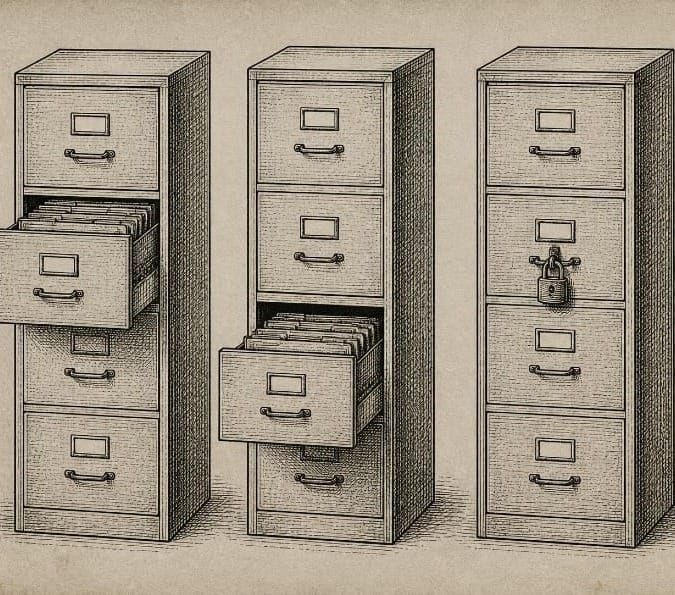
Walking over to the disconnect
- It's three separate jobs, not one. Equifax, Experian and TransUnion each hold their own file, and a freeze at one does nothing at the other two.
- Online or by telephone, the law gives them one business day to put it on. By post, three.
- When you need it off — a car, a mortgage, a new card — they have one hour by law, online or by phone. That's the answer to the objection I'd have raised myself, which is that it'll be in the way when I want to buy something.
- Keep whatever PIN or password each one gives you, in the place where you keep things you'll need in ten years and not before.
- Ask for a freeze. Not a lock. Two different words for nearly the same thing, and only one of them is written into the law.
Two more the same law allows, and I'd not have guessed either. You can freeze a child's file for free until they turn sixteen — which matters, because a child's file is clean and unwatched for two decades. And if you hold power of attorney, or you're somebody's guardian or conservator, you can freeze theirs too.
That second one is the reason I'm writing this on a Friday rather than saving it. If you're looking after a parent's affairs, their file is sitting open in three buildings and nobody is watching it but you.
If a bureau won't put the freeze on, or won't lift it in the time the law gives them, the Consumer Financial Protection Bureau takes complaints on 855-411-2372.
It's an afternoon's work, once, and then it's done. That's a better ratio than anything else I've put in front of you this week.
Wendell
P.S. The lockout rule at the plant had one line in it I thought about for years. Your lock, your key, and nobody removes it but you — not your foreman, not the plant manager, not the man on the next shift. The whole thing worked because there was no one who could open it on your behalf. I don't know that anybody wrote the credit law with that in mind, but it comes out the same: the PIN is yours, and the bureau can't lift the freeze for someone who says he's you.
Sources
Hillebrand & Smith, Free credit freezes are here, 21 September 2018 · Consumer Financial Protection Bureau and Federal Trade Commission
New federal law allows consumers to place free credit freezes and yearlong fraud alerts · Federal Trade Commission
Nothing here is legal or financial advice — this letter reports what the law provides and where the official guidance is published.